

Patio Heater article in the Register
EU to ban the patio heaters that ate the planet. Not.
In space, no one will let you heat... By John Lettice Published Sunday 3rd February 2008 09:02 GMT
An overwhelming majority of EU MPs this week voted for a ban on patio heaters, calling on the European Commission to set a timetable for the withdrawal from the market of these and other "very energy-inefficient items of equipment." But despite what you might read in the popular prints, there are just a few obstacles standing in the way of the immediate death of these planet-wrecking engines of doom.
For starters, what is it about patio heaters that is energy-inefficient? The question is neither frivolous nor jesuitical, if one considers the context. The MEPs were voting to adopt a report on energy efficiency as part of a process initiated by a Commission document, Action Plan for Energy Efficiency. This document proposes a series of measures intended to save over 20 per cent in EU annual energy consumption by 2020, via improvements in insulation, energy use management and the efficiency of energy-using devices.
Patio heaters are at no point mentioned in this document, but they could possibly be considered by the Commission as part of its plan to push for more energy-efficient products, to introduce energy-efficient labeling and to increase consumers' awareness of the energy consumption of the appliances they own. In IT and consumer electronics, good examples of this in action would be standby mode in TVs, monitors and external power supplies. The Commission document isn't specific on standby targets, but the Parliament report calls on the Commission to impose a one watt requirement, and to produce an analysis of the savings that could be made by eliminating standby mode altogether.
Overall, however, the Commission action plan focuses on specific categories of device and appliance with a view to setting minimum performance standards for them in terms of energy efficiency. It doesn't call for the outlawing of specific categories of activity or appliance on the grounds that they're stupid, unethical or evil, it merely attempts to ensure that the energy used by these activities and appliances is used efficiently.
So try that on patio heaters. The most common of these consist of a bottle of gas, a burner and a reflector unit that throws the heat out in a circle around the heater. They're not exactly complicated constructions, and they do pretty much what it says on the tin - they heat patios, pretty effectively. You could certainly argue that it's profligate and wasteful to be heating patios on a cold February night when we should all be snug in our heavily- insulated eco-friendly homes, but it's surely unreasonable to claim they're "energy-inefficient" - if heating patios is what you want to do, they're a pretty damned efficient way to do it. And yes you might argue that it's somehow wrong and against nature to be using these things, but similar arguments could be applied to using electric lights. Or wearing jumpers. Or trying to live in the northern hemisphere in winter.
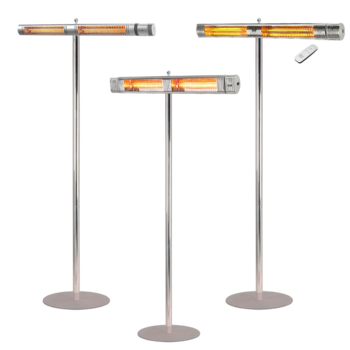
But we'll help the MEPs out on efficiency by explaining how compared to other ways of heating patios, the typical gas patio heater isn't necessarily the most efficient way to do it. According to the Market Transformation Programme, which provides support for the UK government in sustainable energy policy, electricity has a carbon burden that is greater than that of LPG by a factor of 2.3, but electric outdoor heaters can nevertheless be more efficient than LPG heaters because they produce focused radiant heat, and because they can be switched on and off by movement detectors.
So depending on usage, electric heaters could be more efficient than LPG ones. If the area to be heated isn't actually going to be occupied for most of the day, then electricity is probably better, but if it's going to be in continuous use, then it's a question of checking out the carbon audits of the electricity company versus the gas bottle supplier to figure out which is greener. There's a case for electricity, but it's by no means a straightforward one.
The MEPs could have followed the Commission's non- judgmental approach and recommended the production of comparative energy efficiency figures for outdoor heaters, backed up by EU regulations requiring minimum standards. But they didn't do this, they went off-piste and simply called for the outright banning of patio heaters, full stop. And although they claimed do so in the name of energy efficiency, their problem was more likely that they wanted them eliminated because they're wrong, and their use is reckless, dangerous, and morally reprehensible.
So how wrong, reckless and dangerous might that be? How much of the planet are these ludicrous appliances destroying? According to the MTP, gas sales to the outdoor heater market in England in 2006 produced emissions of 22.2 ktCO2. In the wake of the smoking ban, it estimated that emissions could be between 141 and 282 ktCO2 annually. For electric heaters, the emissions could be 96- 192 ktCO2. The UK's total production of CO2 in 2006, according to DEFRA, was 556.5 million tonnes, meaning that the patio heater's share is negligible, even at the upper end of the MTP's estimates. Passenger cars, on the other hand, accounted for a chunky 68.7 million tonnes of the UK's Carbon tab - so are we banning them, then? ®
Read next article.
Electric Patio Heating - The Greener Alternative
Transitioning to electric infrared heating solutions could significantly reduce carbon emissions while still allowing for comfortable alfresco dining. Infrared rays do not heat the air; instead, they only have an effect once they hit a solid object. Infrared heat will penetrate the skin and warm you from beneath your skin.
Here are 4 of our most popular infrared heaters.